Interactive physics program
An interactive physics program I built for a study of tenth-grade students, which won the Research Excellence Award from the West Gaza Education Directorate.
- Research project
- 2017
- The study (PDF, Arabic)
Overview
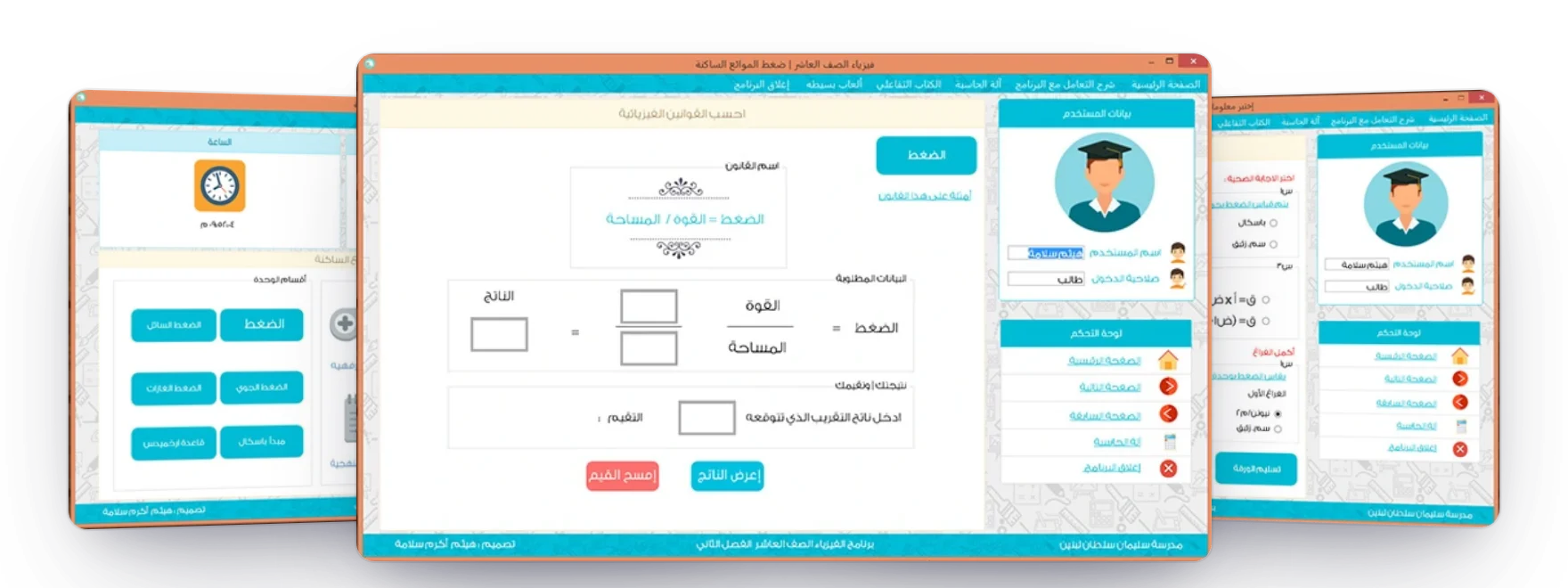
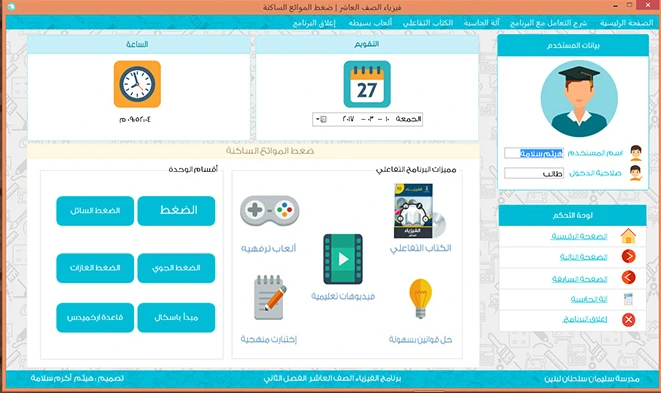
A desktop program in Arabic for the static fluids unit of tenth-grade physics, with lessons, short videos, a law solver and tests. I designed and built it at Suleiman Sultan Basic Boys' School in Gaza, for a research study I wrote with two classmates under the school's research committee. The study won the Research Excellence Award from the Ministry of Education's West Gaza Directorate in 2017.
The problem
Many students at my school struggled with physics.
- A hard subject. Students found it difficult and put off studying it.
- Little motivation. Few were keen to learn it, and the study asked whether an interactive program could change that.
The solution
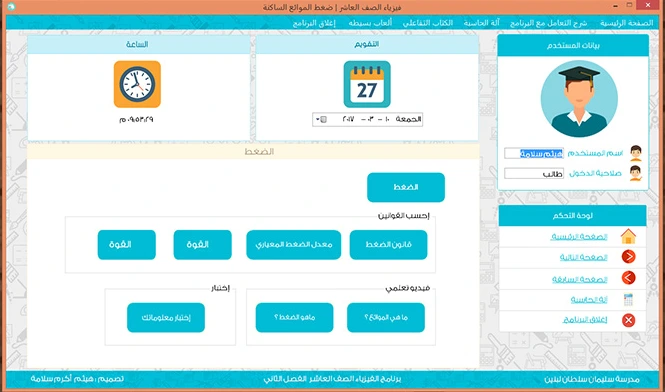
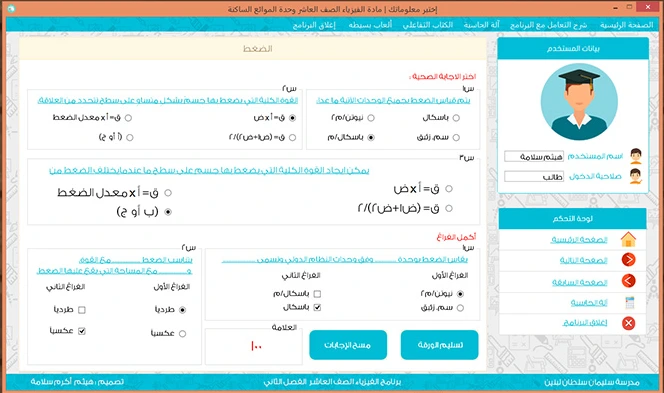
The whole unit in one place. The unit is split into six sections, each with the interactive book, videos, a law solver and a test, and a calculator and simple games are always one click away.
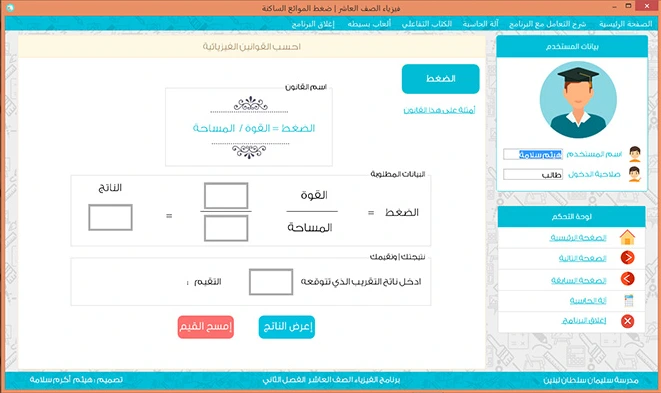
An estimate before the answer. In the law solver, students enter the values and their own estimate first, then reveal the result, so they think about the answer before they see it.
What I did
- Designed and built the program, from the sign-in screen to the tests.
- Wrote the study with two classmates, supervised by the school's research committee: the research question, a survey of 15 statements and its analysis.
What it offers
- Six sections, one unitPressure, liquid pressure, atmospheric pressure, gas pressure, Pascal's principle and Archimedes' principle.
- The interactive bookThe unit's book, one click away from every screen.
- Short videosVideos that answer questions such as "What are fluids?" and "What is pressure?".
- A law solverPick a law, enter the values and your estimate, then see the result.
- Tests with a markMultiple-choice and fill-in-the-blank questions, marked out of 100 when handed in.
- Simple gamesGames and a calculator beside the lessons.
The study
We surveyed a random sample of 70 of the school's 1,180 students. In each part of the survey, one statement came out on top: physics is a hard subject, the videos were the best part of the program, and the program raised their motivation to learn physics. We recommended interactive programs for more subjects, and training for teachers in newer ways to teach science. You can read the full study (PDF, in Arabic).
In the product